
 We've sold a bunch but they're still in stock: 2010 Jim Flora calendars. The spunky hyperactive figures date from Flora's mid-1950s RCA Victor LP period. Each calendar is letterpress printed one color at a time on card stock, and accessorized with a 12-month tearaway calendar. Buy one ($12.50) or a set of three at the Little Shop of Flora's. These keepsake datekeepers were produced by Yee-Haw Industries, of Knoxville.
Sunday, January 3, 2010
Flora 2010 calendars
We've sold a bunch but they're still in stock: 2010 Jim Flora calendars. The spunky hyperactive figures date from Flora's mid-1950s RCA Victor LP period. Each calendar is letterpress printed one color at a time on card stock, and accessorized with a 12-month tearaway calendar. Buy one ($12.50) or a set of three at the Little Shop of Flora's. These keepsake datekeepers were produced by Yee-Haw Industries, of Knoxville.


Monday, December 14, 2009
The Stationmaster's Daughter
 The full title of this undated (early- to mid-1940s) work is The Rape of the Stationmaster's Daughter, a tempera on paper, titled in pencil on the reverse. It was reproduced in our second Flora anthology, The Curiously Sinister Art of Jim Flora, and its anatomically absurd actors were adapted by designer Laura Lindgren for the cover. In 2008 we issued a fine art print.
 A customer purchased a print last month and expressed admiration at the quality of both the work and the replica. But truth to tell, our Stationmaster print has not sold well. I suspect the subject matter creeps people out. It's sinister and diabolic—and goes beyond mere mischief. Who wants a cartoonish depiction of a sexual-assault-in-progress adorning the living room?
Yet this work will always be special to me. At the time Barbara Economon and I compiled our first book, The Mischievous Art of Jim Flora, in 2004, we had seen very little of Flora's early fine art. He was primarily known for his album covers and commercial music iconography, topical magazine illustrations, and children's books. What fine art of Flora's we had seen consisted mostly of his large, late-period maritime canvases, which did not capture our interest.
 When I was first shown (by Flora's family) his fine art collection in storage on a rainy Saturday in October 2005, one of the first works pulled from a jammed portfolio was Stationmaster. I ogled it with amazement. It was gorgeous, even as it was disturbing. It was a depiction of evil, yet it had a magical quality, transporting me to another world, revealing the deeper Flora artistic vision that had been a family heirloom to that point. I didn't see darkness in the tableau. The aged, pigment-soaked paper evoked the privately creative side of Flora during the 1940s. I never forgot that moment: the birth of an obsession.
We don't know if the work was based on a historical incident or simply reflects Flora exorcising his demons with a paint brush. Barbara's color-matched print faithfully captures the original, right down to the muddy backwash. You can almost feel the brushstrokes.

Saturday, December 12, 2009
Floraville skyline
 Unlettered page from Primer for Prophets booklet, 1954. This image will not be part of our screen print alphabet series.
Thursday, December 3, 2009
a curiously sinister lachrymosity
 Detail, Okeh Records retail banner for then-new (1943) 78 rpm disc "Born To Lose" by Ted Daffan's Texans. The grieving beau has an odd tic: crying out of one eye, thereby expressing semi-sorrow over the loss of his gal.
The full banner was reproduced in our second anthology, The Curiously Sinister Art of Jim Flora.
Sunday, November 29, 2009
crimestoppers
 Great detail (extracted at the Print & Pattern blog) from Flora's mid-1960s painting The Big Bank Robbery. We issued a limited edition fine art print of the work earlier this year.
The backstory on the work is unknown. It may be a generic bank hold-up, or based on a specific historic incident. No documentation from the artist is known to exist.
Thursday, November 26, 2009
more anatomical spare parts
 Detail from the Lord Buckley 10" EP Hipsters, Flipsters, and Finger-Poppin' Daddies, Knock Me Your Lobes, released on RCA Victor in 1955. Left to right: sports-fan centaur, polycephalic saxophonist, jubilant wench. Body count: three figures, eight legs, four heads.
We issued a (very) limited edition print (10) of this iconic Flora cover in 2007. Copies of the original cover fetch beaucoups bucks on Ebay.
Tuesday, November 24, 2009
the cognitive process
 Flora explains how the brain reacts to stimuli—it's all cogs, pulleys and tiny hammers. Another (see below) illustration from the November-December 1944 issue of Columbia Coda.
Sunday, November 22, 2009
phantom septet
 Illustration, Columbia Coda, November-December 1944. The pianist is ... we'll get back to you on that. The clarinetists and violinists, forced to perform incognito due to union regulations, were represented on the session by essential anatomical components attired in boots and bowties.
Wednesday, November 18, 2009
inside the art factory
We recently launched our third series of alphabetical Primer for Prophets screen prints (see preceding post). Minneapolis printmaker Dan Ibarra of Aesthetic Apparatus, where the series is produced, sent us snapshots of the production process:
Detail of WASHED:

First inking of ECONOMIZED:

Drying racks with ganged images after first ink pass:

Finished, dried, stacked, untrimmed prints:
 We've now produced prints for the letters A, C, D, E, G, J, K, N, Q, S, U, and W (14 to go). While developing series 3 over the summer, Barb and I selected "U" (Underestimated) in anticipation of printmaker Dan's and wife Kelly's first child, expected in the fall.
 Clover Isabel Ibarra was born 9 lbs, 7 oz at 9:31 pm, Wednesday, October 21, at St. Joseph's Hospital in St. Paul.
 No triplets this time.
About Clover's birth, Dan writes:
Detail of WASHED:

First inking of ECONOMIZED:

Drying racks with ganged images after first ink pass:

Finished, dried, stacked, untrimmed prints:
 We've now produced prints for the letters A, C, D, E, G, J, K, N, Q, S, U, and W (14 to go). While developing series 3 over the summer, Barb and I selected "U" (Underestimated) in anticipation of printmaker Dan's and wife Kelly's first child, expected in the fall.Clover Isabel Ibarra was born 9 lbs, 7 oz at 9:31 pm, Wednesday, October 21, at St. Joseph's Hospital in St. Paul.
 No triplets this time.
About Clover's birth, Dan writes:
Assisted by our three amazing midwives and a slew of other nurses at St. Joseph's, we attempted innumerable ways to get Clover in the right position and deliver her through a natural child birth. The labor was extremely hard on Kelly (as 72 hours of labor can be) and in the end we exhausted all options and had to perform a Caesarian. Although we really struggled hard to avoid as little medical intervention as possible it turns out that complications with the umbilical cord around the baby's neck and the position of her head prevented anything of the sort.
Clover was amazingly tough through the whole labor, rarely ever showing any fluctuation in heart rate or stamina. Some people say that how we are born is very telling of our personality. If that's the case, this new little girl is already the toughest, most cool-headed girl we've ever known. (Maybe Clover Eastwood might have been a better name?)
Sunday, November 15, 2009
Primer for Prophets 3rd series


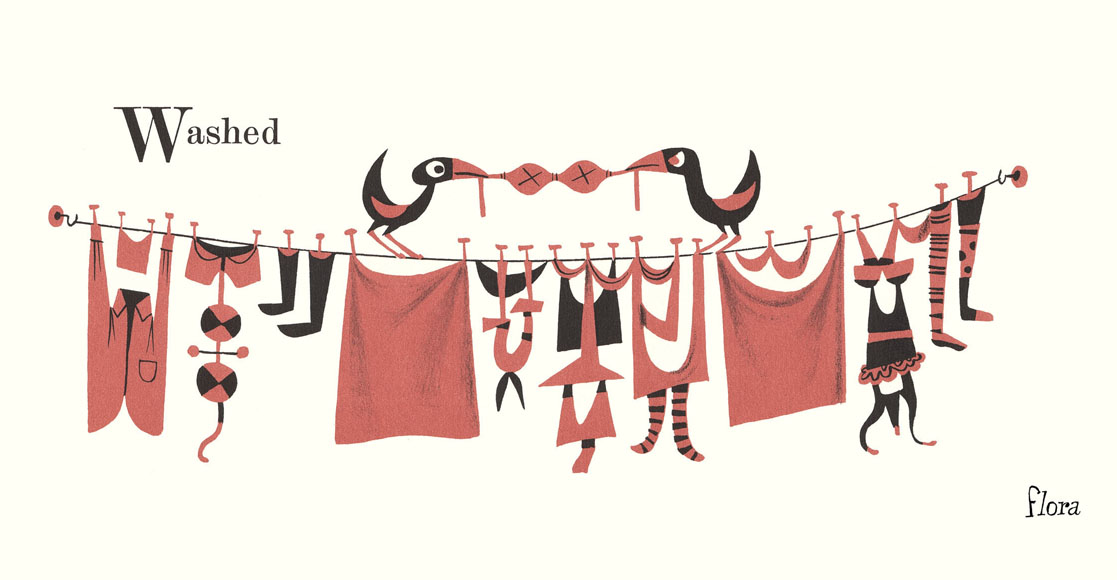 NOW AVAILABLE: the next four works in the Primer for Prophets screen print series. Cool Flora illustrations of the American nuclear family during the 1950s, when grocers employed stockdogs, crows fought tug-of-war over lingerie, and cigarettes were obligatory in the obstetrics ward. The images derive from a 1954 trade-only alphabet booklet that Flora illustrated for CBS-TV, depicting consumer markets for prospective TV advertisers.
The third set of prints features ECONOMIZED, NURSED, UNDERESTIMATED, and WASHED. Each work has been produced in an edition of 100, each hand-numbered and authenticated. Individual prints sell for $50, and a full set (four prints) can be obtained for $175. Full sets can be purchased via any of the single-print pages at JimFlora.com.
Series 1: Ate, Drove, Jived, and Smoked. Single prints: $60 (except Jived: $125); set: $200.
Series 2: Cooked, Groomed, Kissed, and Quaffed. Single prints: $50; set: $175.
Monday, November 9, 2009
Flora crosses the pond

A pdf of the five pages can be downloaded here. (The pages will be online at Telegraph.co.uk shortly.)
Saturday, November 7, 2009
Meow! Introducing the Mambo Mini
 Our large (20" x 20") Mambo For Cats limited edition screen print is almost sold out. We're now offering a miniature (7" x 7") giclée open edition print of this renowned Flora 1955 RCA Victor LP cover. At $25.00, it's a great alternative for those on a limited budget—or with limited wall space.
Wednesday, November 4, 2009
three legends
 Three jazz legends, stacked, in the July 1952 issue of Coda, Columbia's new release monthly. From the top:
Harry James (trumpet)
Benny Goodman (clarinet)
Art Tatum (piano)
Each had a new LP that month: James with Soft Lights, Sweet Trumpet, Goodman's Let's Hear the Melody, and Art Tatum Concert.
As art director, Flora launched Coda in 1943, and provided most illustrations for the (largely classical music) monthly until he was named Sales Promotion Manager in 1945. This change of desk deprived him of artistic assignments. (Coda morphed into Disc Digest under new art director Robert M. Jones.)
In 1952, when Flora was a hustling freelancer, Columbia hired him to revive the publication. By then, Coda—in a downsized format—showcased the label's jazz, popular, and ethnic music roster. It lasted less than two years, by which time Flora had greatly expanded his client base. But because it was a music-related gig, he probably would have continued illustrating Coda as long as Columbia kept the monthly alive.
Monday, November 2, 2009
Jim Flora notecards
 Back in stock: letterpress-printed cards with cool 1940s and '50s music and turntable illustrations by Flora. The cards were designed and printed by our friends at Yee-Haw Industrial Letterpress, in Knoxville. Packaged in sets of four: Dig You Later, Stardust Moon, Deluxe-O-Tone, and Trees.
Saturday, October 31, 2009
spooky doings
 Perhaps the kid dropped his bag of trick-or-treat candy (and shed his costume) sprinting for safety. Illustration from introductory chapter of A Red Skel(e)ton in Your Closet, a 1965 anthology of "ghost stories gay and grim" selected for young readers by popular film & TV comedian Red Skelton. The book contains 21 interior illustrations which are uncredited, but Flora's trademarks are unmistakable. The artist was under contract to Harcourt, Brace at the time, and in all probability was prohibited from artist attribution for illustrations in children's books issued by other publishers (this volume was a Grosset & Dunlap title). The best of the Skel(e)ton illustrations were reproduced in our recent book, The Sweetly Diabolic Art of Jim Flora.
Wednesday, October 21, 2009
Gene Krupa demo booklet (1941)
 Dummy pages, Gene Krupa and his Columbia recording orchestra, demo booklet, 1941, part of a series of homemade samples prepared by Flora for the Columbia Records art department. Most pages from the booklets (which earned the artist a job at Columbia) were reproduced in The Curiously Sinister Art of Jim Flora; three of the above four pages were omitted due to space constraints. We posted another unpublished page from the series here and more Flora artistic impressions of the great jazz drummer Krupa here.
Thursday, October 15, 2009
seaside setting
 Detail (about two-thirds of the complete work) of an untitled, unpublished tempera on board, ca. mid-1960s. The collection contains a number of similarly composed maritime paintings from this period, though colors and figures vary. If you have our recent book, The Sweetly Diabolic Art of Jim Flora, compare this setting with Salt Pond—Block Island on page 54.
Monday, October 12, 2009
Reptet rides again
 ... this time to a distant galaxy. Or maybe just down the block to the Moon. The genre-surfing Seattle combo has once again (third time) licensed a Jim Flora illustration for a cover, their new 7" vinyl release Agendacide. The above element derives from the April 1963 cover of Computer Design magazine.
Previously the band's John Ewing licensed images for the Reptet's CDs Do This! and Chicken or Beef. This helps carry the Flora mid-20th album cover legacy into the 21st century, and we appreciate the torch-bearing efforts of Mr. Ewing and his cohorts. Their website is also adorned with details from other Flora works.
Friday, October 9, 2009
Bessie Smith and someone like Bessie Smith
Here are two tempera illustrations discovered in an early- to mid-1960s sketchpad in the Flora collection. The more refined of the two works has a title: Bessie Smith, presumably a vignette of the soulful, bawdy 1920s and '30s Empress of the Blues. The pianist (great hat!) is unidentified, and we can't vouch for the historical accuracy of Smith performing with her nipples exposed:
 The second work, pages away in the same sketchpad, is untitled but appears to be an unfinished draft of the same scene:
 It appears that Bessie gained quite a bit of weight between conception and refinement. Then again, Flora might not have had Smith in mind for the pencil and tempera draft. He often changed titles of near-identical works; many sketches were untitled, or assigned working titles which were altered for subsequent variations. A 1940s pencil sketch tagged "Boss Crump" evolved into a painting titled Self-Portrait. We'll never know at what point the artist decided that his resemblance to the legendary Tenneesse pol E. H. Crump was undeniable. A 1942 illustration for Columbia Records depicted conductor Fritz Reiner with four arms, three eyes, two noses and dueling mouths. The exact same figure was revisited in 1998—the similarity is unmistakable—but retitled Daniel Berenboim, another legendary conductor.
Wednesday, October 7, 2009
Jim Flora 2010 calendars available
 We've received no reports of malfunctioning 2009 calendars—every day has thus far been accounted for, in the correct sequence—so we're offering 2010 models, hot off Yee-Haw's industrial presses. The spunky hyperactive figures date from Flora's mid-1950s RCA Victor LP period. Each calendar is letterpress printed one color at a time on card stock, and accessorized with a 12-month tearaway calendar. Buy one ($12.50) or a set of three at the Little Shop of Flora's.
Subscribe to:
Posts (Atom)


