Thursday, June 3, 2010

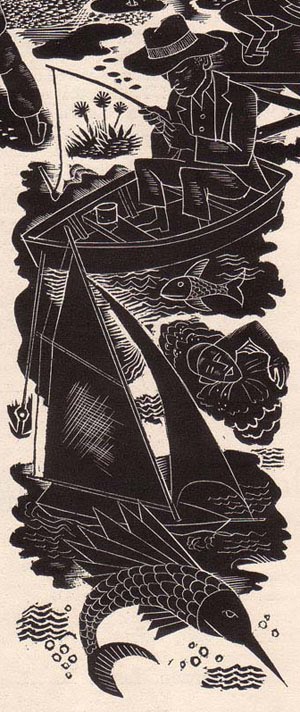
fishing in New Orleans

Detail from a series of woodcuts Flora produced as a freelancer for the Union Central Life Insurance Company of Cincinnati around 1940. They were reproduced in UCL's monthly Agency Bulletin to illustrate articles about the history and legacy of the Crescent City. The images proved so popular they were issued as a limited edition folio by the company in 1942.

Flora later admitted that at the time he produced the woodcuts, he had never visited New Orleans; he'd based his images on photos of the city and on literature about the region.

A previous post about this woodcut series depicted Jackson Square.

Sunday, May 30, 2010

Benny Goodman @ 101

Jazz clarinetist Benny Goodman, as portrayed by Flora for the March 1952 issue of Columbia's monthly Coda new release booklet. Goodman was a founding father of the mid-1930s jazz big band ("swing") style—launched in force after he hired arranger Fletcher Henderson in 1935.

As he matured, he performed and recorded classical repertoire; the above figures illustrated Coda's preview of Goodman's recording (with the American Art Quartet) of Mozart's Quintet for Clarinet and Strings.

Flora was a fan of Goodman, and rendered him many times for Columbia and RCA Victor releases and promotional material. Asked about his encounters with the jazz musicians he illustrated, Flora told me (in 1998):
I didn't get to know many of them intimately. Benny Goodman I knew better than any of them. I did some photographic sessions with Benny. He was always difficult to get along with, but I never had any problems.
Goodman was born this day in 1909.

Tuesday, May 25, 2010

Charlie Yup (endpapers)

Left half of endpaper, Charlie Yup and His Snip-Snap Boys, Flora's third children's book, published in 1959. This seems to be the rarest of Flora's out-of-print kid-lit. Antiquarian book dealers ask three figures for used copies. This book also betokens the end of Flora's classic, edgy 1950s commercial illustration style, which became tamer in the 1960s.

Friday, May 21, 2010

unfinished dancers

Unfinished pencil and tempera sketch, ca. 1950-51 (Flora's Mexican sojourn), found in artist's notebook. There's no evidence the work was refined or adapted for any other purpose. The ghost image in the background is the bleedthrough of a series of figures on the reverse.

The left figure above has some female attributes, the right some vague echoes of manhood. Regarding the lady, we won't speculate on what's protruding from her butt or clustered in her belly, nor will we venture an opinion on the chopsticks positioned in her crotch.

Sunday, May 16, 2010

Woody Herman

Bandleader/clarinetist Woodrow Charles "Woody" Herman (1913-1987) rendered by Flora in the June 1946 issue of Columbia Records Disc Digest. Flora used alternating-color patterns throughout his career (see examples here, here and here). Because he was partly color-blind, skin tints were irrelevant.

Herman was born today 97 years ago (less than a year before Flora).

Thursday, May 13, 2010

Mardi Gras Quartet

Yesterday we (officially) launched our latest limited edition screen print series, Mardi Gras Quartet. (They've been "unofficially" available on our website for months.) Based on an early 1950s series painted by Flora while living in Mexico, each print is identical except for color scheme. The original four variants, along with sketches and figure studies (displayed at the bottom of the linked print page), were reproduced in our second book, The Curiously Sinister Art of Jim Flora (2007).

The Mardi Gras screen prints were produced in a limited edition of 125 each by Minneapolis print/design studio Aesthetic Apparatus, working from Flora archivist Barbara Economon's digitally restored and color-proofed high-resolution scan of the original art (tempera on artist board).

Each of the four prints can be purchased individually ($30/ea.), in multiple combinations, or as a full set ($100). Prices will increase for subsequent prints as the edition depletes.

Friday, May 7, 2010

food chain 2

Detail, Sherwood Walks Home, Flora's eighth children's book, 1966. We won't reveal the outcome, but we suspect the cat is the most determined diner.

Tuesday, May 4, 2010

science geek 4

Untitled acrylic on board, ca. mid-1960s. This modular work echoes illustrations Flora provided for the covers of Computer Design magazine during the 1960s and '70s. We've yet to determine whether this painting or an adaptation actually graced a CD cover. If not, this blog post might represent its first public exposure (we haven't reproduced this work in any of our Flora anthologies to date).

Saturday, May 1, 2010

Fresh ink and Flora tattoo #2


Some people dedicate their bodies to science. Shannon Wade, of Portland OR, dedicates hers to the art of Jim Flora. Not the first time, either.

The above distended figure originally appeared on the title page of GUP, a 1942 Little Man Press publication written by Robert Lowry and illustrated by Flora.

Wednesday, April 28, 2010

Le Sacre du Printemps

Flora created the Columbia Records new release monthly Coda in early 1943 and illustrated most issues thru 1945 (after which the journal morphed into Disc Digest). The March 1944 issue is one of Flora's most satisfying on an artistic level. The cover (above) illustrates a Columbia Masterworks four-disc album (price: $4.50) of Igor Stravinsky conducting his own Le Sacre du Printemps (The Rite of Spring), described in Coda as "a ballet based on the paganistic rituals of prehistoric Russia." The 1913 work's tumultuous history (it sparked riots) is chronicled in the release notes.

Many of the interior illos of this Coda issue were reproduced in our third anthology, The Sweetly Diabolic Art of Jim Flora.

Monday, April 26, 2010

Ferris Wheel Fireworks (new print)

Today we launch a new Jim Flora fine art print: Ferris Wheel Fireworks, adapted from Flora's second kiddie book, The Day the Cow Sneezed (1957). The long-sought book will be reprinted this fall by Enchanted Lion. At that time we'll issue a print of the book cover, which includes the artist's fabulous hand-typography. However, during the image restoration process, Flora archivist/printmaker Barbara Economon saw the print possibilities of the book's chaotic two-page (34-35) tableau. The book's sequence of catastrophic events that caused the above turmoil were triggered by a cow's sneeze.

The work is now available as a limited edition (30), archival-quality fine art print.

Tuesday, April 20, 2010

Flora as interior decor

Akiko Hashimoto sends this snapshot from her home in Japan:

The Flora prints displayed are The Big Bank Robbery (ca. 1963) and Gunfight on the Roof (ca. 1951). A series of original 1950s Flora LPs sits on a shelf below.

Friday, April 16, 2010

Fletcher Henderson

Fletcher Henderson, tempera on paper, 1942, as reproduced in our third anthology, The Sweetly Diabolic Art of Jim Flora. In the 1920s, exploring ideas gleaned from orchestra leader Paul Whiteman, pianist Henderson created the template for what evolved into the jazz "swing" big bands of the 1930s. He was one of the most influential musicians/bandleaders of the 1920s, but others achieved greater and more lasting fame developing concepts pioneered by Henderson.

Flora, a lifelong jazz enthusiast, rendered a number of works named after Henderson, including at least two sketches and two paintings.

The original was purchased from the artist by Eric Kohler in the 1990s. We thank Eric for providing the work for reproduction.

Thursday, March 25, 2010

Celebrities (mini print)

New launch: a miniature (7" x 8") giclée open edition print (at $25/ea.) of a previously unpublished and uncirculated mid-1990s Flora pen & ink drawing. Celebrities portrays anonymous showbiz figures as freakshow caricatures. This is our second open edition, low-cost fine art print; Mambo For Cats was launched last October.

Sunday, March 21, 2010

moptops on deck

Untitled pen & ink and tempera (or watercolor) on paper from the late 1980s/early 1990s, featuring a colorful zoom-in on an ocean liner with three faceless moptops on deck. This work dates from the close of Flora's maritime period (1980s), probably around the time, as he told an interviewer in the 1990s, that he'd "painted himself out of ships." His large maritime canvases of the 1980s were historically based, spectacularly detailed and less primitive. In the early 1990s his fine art reverted to a more playful and elemental style reminiscent of his work from the 1940s thru the mid-1970s.

Sunday, March 14, 2010

Charlie and Wallingford

Caution: archivists at work. Snapshot of two 1943 artifacts parked on a collapsible card table at CT storage facility housing Flora collection. Larger work is Charlie's Egg, a tempera on (the back of a) Columbia Records convention brochure; the bottom partial is one of two covers for an unpublished kiddie book, The X-Ray Eye of Wallingford Hume. Both images were fully reproduced in our third Flora anthology, The Sweetly Diabolic Art of Jim Flora.

Photo: Don Brockway, May 2006

Wednesday, March 10, 2010

Bix @ 5 score + 7

Columbia Coda, April 1952, listing 7" discs featuring recordings of legendary jazz cornetist Bix Beiderbecke, born this date in 1903. The page is crowned with a Flora horn. At the time this circular was published, Beiderbecke would have been a relatively young age 49—if he hadn't died 21 years before (which was 17 years before the introduction of the 7" disc). We wrote about Bix @ 106, chronicling his enormous musical significance as well as his self-destructive predilections.

Monday, March 8, 2010

Love (and some of its aspects)

Detail, The Many Aspects of Love, tempera on board, mid-1990s (and pre-dated by a pen & ink drawing). Not a top-tier work, the above partial reflects the extended mayhem. While there's plenty of vestigial Flora mischief (note demons in the head at left), works like The Many Aspects veer perilously close to self-parody. The complete work has not been published.

Friday, March 5, 2010

decapitation = success

Spot illustration, Research & Engineering magazine, April 1956, showcasing the secret to corporate achievement: sever your rival's head. The sword-wielding executive regiment works most effectively when your competitor is a sawtoothed reptile. In the above illustration the exec-suite platoon seems to have arrived after the fact, as evidenced by the detached noggin and "+" in place of eyeballs, which in cartoons usually signify death.

Tuesday, March 2, 2010

circus cavalcade

Top half of 1948 Columbia 78 rpm two-disc sleeve, Come to the Circus. The complete cover and interior illustrations were reproduced in The Mischievous Art of Jim Flora. The 2004 book featured most then-known Flora covers from his Columbia and RCA Victor years. We have since discovered others, and are searching for a handful of strays that (based on archival clues) may or may not exist. Rather than include recent discoveries in our subsequent Flora anthologies, we plan to eventually publish a complete stand-alone collection that will include sketches and alternate drafts from the Flora archives.
